

Can foreigners buy beachfront property in Panama?
By Gustavo Szuchman, Papaya Holdings · Published · Last updated
Yes. Foreigners can own property in Panama, including land next to the beach, with the same rights as Panamanian citizens. The two main exceptions are land within 10 km of a national border and island territory owned by the State, and neither applies on the Azuero coast at Playa Venao or Playa Raya. What no one can own, foreign or Panamanian, is the beach itself: on the Pacific coast the first 22 metres inland from the high-tide line are public. So the real questions are what exactly a "beachfront" lot includes, whether it is titled, and how you hold it.
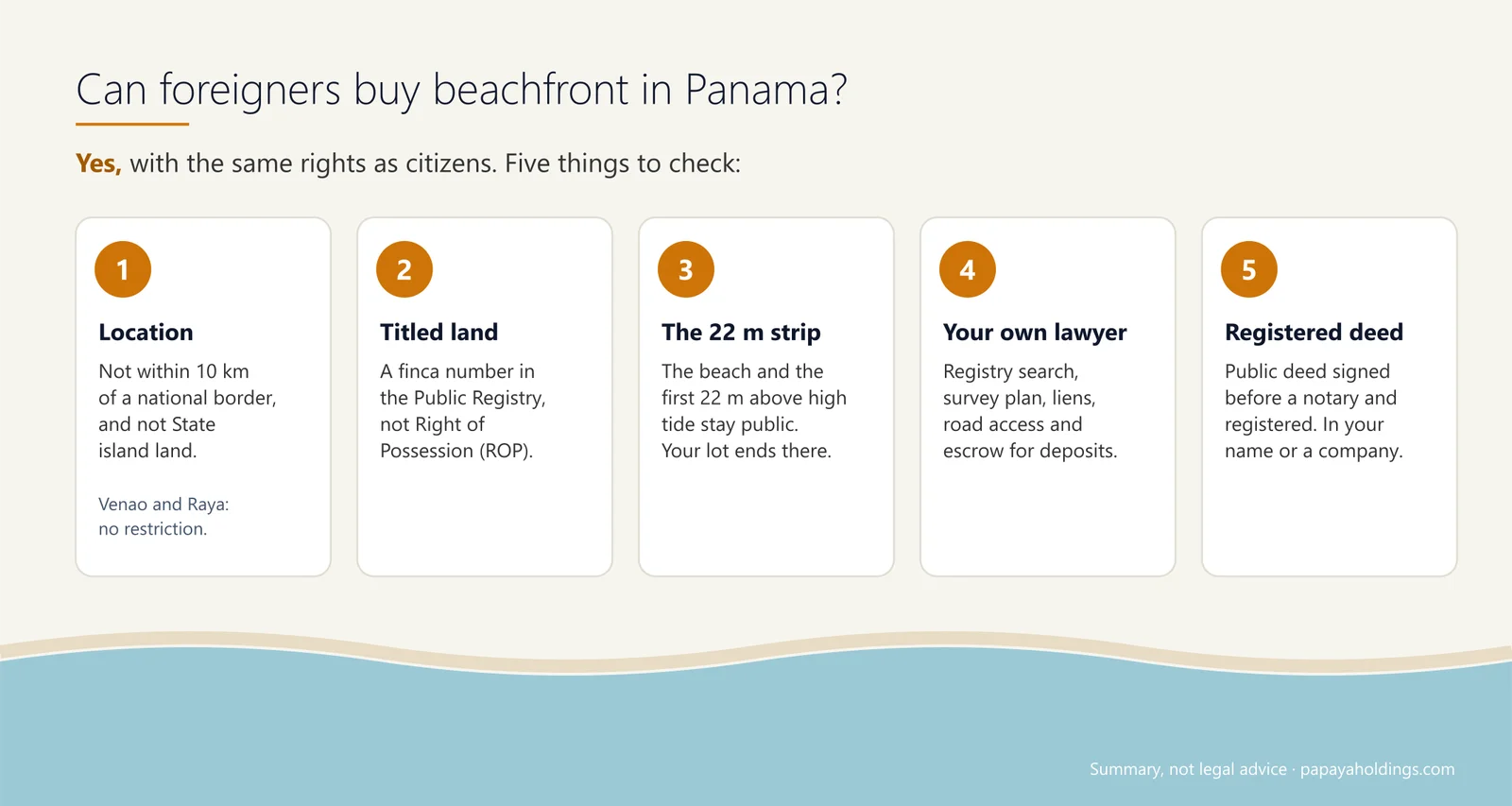
The short answer at a glance
| Question | Answer |
|---|---|
| Can a foreigner own property in Panama? | Yes, with the same rights as a citizen. No residency is required to buy. |
| Where can't foreigners buy? | Land within 10 km of a national border (Costa Rica or Colombia). State-owned island land can only be sold for specific development purposes. |
| Can I own the beach? | No. Beaches are public, and on the Pacific the first 22 m above the high-tide line (ribera de playa) can never be titled. |
| What does "beachfront" mean in practice? | Titled land that runs up to the edge of the 22 m strip. |
| What about the 200 m coastal zone? | Land there can be titled, but it is where possession claims, setbacks and environmental rules apply. |
| Titled or ROP? | Buy titled land, registered in the Public Registry with its own finca number. |
| In my name or a company? | Either. Both are common; ask your lawyer about tax and inheritance. |
| Playa Venao and Playa Raya | Not near a border and not on an island, so the normal rules apply. |
Can foreigners own property in Panama?
Yes. Panama treats foreign buyers the same as its own citizens. You can hold land, a house or an apartment in your own name, with full ownership registered in the Registro Público (Public Registry), and you can sell it, mortgage it or leave it to your heirs. You do not need to live in Panama or hold a visa to buy, although owning property can support some residency applications, such as the Qualified Investor visa.
There are two exceptions, both in Article 291 of the Constitution:
- The 10 km border zone. Foreign individuals, and companies with foreign capital, cannot acquire national or private land less than 10 kilometres from Panama's borders with Costa Rica and Colombia. Using a Panamanian company does not get around this rule, because it also covers companies with foreign shareholders.
- Island territory. The State's island land can only be sold for specific national development purposes. On many islands, much of the land is not titled at all, so buyers are offered rights of possession instead (see below).
Playa Venao and Playa Raya sit on the southern coast of the Azuero Peninsula in Los Santos province, far from either border and on the mainland. Neither exception applies.
What you can and cannot own on the beach
This is where most of the confusion comes from. Panama's Constitution (Article 258) places beaches and their shores in the public domain, and Law 80 of 2009 sets out the coastal strips.
- The ribera de playa (22 m). On the Pacific coast, the strip from the high-tide line to 22 metres inland is public. It cannot be titled to anyone. (On the Caribbean side it is 10 metres.) You cannot fence it, build on it or stop people walking along it.
- The coastal zone (200 m). The band from the high-tide line to 200 metres inland can be titled under Law 80's rules. It is also where untitled possession claims are most common, and where setbacks and environmental approvals matter most for building.
- Public access. Land grants must keep easements that let the public reach the beach, and Law 80 sets fines for blocking access.
- Mangroves cannot be titled as private property.
So a "beachfront" lot is titled land that ends where the 22 m strip begins, not at the water's edge. A good survey plan shows where the high-tide line and the 22 m line fall, and you should walk them before you sign. Some structures close to the shore need a separate concession from the State, which is a time-limited right of use, not ownership.
Titled land or Right of Possession
Much of Panama's coast was never formally titled. Instead of a finca in the Public Registry, the seller holds a Right of Possession (ROP, or derechos posesorios): a recognised right to occupy and use land that still belongs to the State. Foreigners can buy ROP, but it is a claim, not ownership, and it only becomes property if ANATI later grants title. Banks generally will not lend against it, and resale is harder.
For a beach purchase, insist on titled land with its own finca number, and check that number in the Public Registry before you pay anything beyond an escrowed deposit. We explain the difference in full in titled vs ROP land in Panama.
Holding title: in your own name or through a company
You can register the property:
- In your own name (or jointly). This is the simplest option and needs no extra structure or annual fees.
- Through a Panamanian corporation (sociedad anónima) or a private interest foundation. Buyers choose this for privacy, for estate planning, or to sell later by transferring the company. It adds a registered agent, an annual government fee and accounting, and the tax effects of selling shares rather than property have changed over the years.
- Through a company in your home country. This is possible, but the company has to be recognised in Panama, and your home-country tax rules then apply as well.
Which is better depends on your country of tax residence, your heirs and your plans for the property. This is a question for your own lawyer and tax adviser, not the seller. Whatever you choose, the 10 km border rule applies in the same way.
The steps to buy beachfront property as a foreigner
- Hire your own Panamanian lawyer, independent of the seller, developer and broker.
- Get the finca number and have the lawyer search the Public Registry: registered owner, area, mortgages, liens, easements and court cases.
- Check the survey plan against the Registry area and the land on the ground. On a coastal lot, confirm where the high-tide line and the 22 m strip fall, and how public beach access is provided.
- Check zoning, building rules and environmental limits: height, density, setbacks, mangroves and river margins.
- Confirm legal road access and utilities at the boundary. Our guide to water, power and internet in Playa Venao and Playa Raya covers what to ask.
- Sign a promise to purchase (promesa de compraventa) with the deposit held in escrow, released only on agreed conditions.
- Send funds through a bank with clear documentation of their origin. Panamanian banks and notaries will ask for it.
- Sign the public deed (escritura pública) before a notary, pay the transfer and closing costs, and get the tax clearances.
- Register the deed in the Public Registry. You own the property only once it is registered.
The full sequence, with timings, is in how to buy property in Panama as a foreigner, and the costs are in property taxes and closing costs. Use the pre-purchase checklist before you commit.
How this applies at Playa Venao and Playa Raya
- No special restrictions. The Azuero coast is mainland and far from any border, so foreign buyers have the same rights as Panamanians.
- Check every lot. Playa Venao is an established community, while Playa Raya is earlier in its development. In both places, confirm the title, the 22 m line and beach access for any lot you are offered.
- Papaya Holdings sells titled property only. Casa Valley, Cove, Vista Verde and the Playa Raya lots are all titled, and each Playa Raya lot has its own finca number in the Public Registry.
For the wider picture, see the buyer's guide and Playa Venao real estate. If you have a question about a specific lot, contact us.
Frequently asked questions
Can foreigners own property in Panama?
Yes. Foreigners have the same property rights as Panamanian citizens and can hold full title in their own name or through a company. The main exceptions are land within 10 km of a national border and State-owned island land.
Can a foreigner own beachfront land in Panama?
Yes, up to the edge of the public beach strip. On the Pacific coast the first 22 metres inland from the high-tide line (the ribera de playa) is public and cannot be titled to anyone, Panamanian or foreign.
Do I need residency to buy property in Panama?
No. You can buy and register property without living in Panama or holding a visa. Some residency programmes, such as the Qualified Investor visa, can be based on a property investment.
Is it better to buy in my own name or through a Panamanian company?
It depends on your tax residence, your heirs and your plans for the property. Owning in your own name is simpler. A corporation or foundation can help with privacy and estate planning, but it adds annual costs. Ask your own lawyer and tax adviser.
Can foreigners buy property on Panama's islands?
Often, but check carefully. State-owned island land can only be sold for specific development purposes, and on many islands land is held as Right of Possession rather than titled property.
Can I build right up to the beach?
No. Nothing can be built on the 22 m public strip, and setbacks, environmental rules and building permits often require more distance. Ask your lawyer and architect what applies to the specific lot.
Can foreigners buy property in Playa Venao?
Yes. Playa Venao is on the mainland and far from any border, so the normal rules apply. Buy titled land and check the finca in the Public Registry.
Sources
- Constitution of Panama, art. 291 (foreigners and companies with foreign capital cannot acquire land within 10 km of the borders; island territory can only be sold for specific development purposes) and art. 258 (beaches and their shores are public domain). Current text: Gaceta Oficial 25176 (2004). The same provisions are art. 286 and art. 255 in the 1994 text on Wikisource — https://es.wikisource.org/wiki/Constituci%C3%B3n_de_Panam%C3%A1_(1994)
- Panama's list of reservations in its trade agreements (MICI), citing arts. 290–291 of the Constitution for the 10 km border rule, including Panamanian companies with foreign shareholders — https://mici.gob.pa/wp-content/uploads/2022/06/lista-panama-anexo-i.pdf
- Law 80 of 2009: art. 2.3 (ribera de playa: 22 m Pacific, 10 m Atlantic), art. 2.4 (zona costera 200 m), art. 10 (mangroves not titled), art. 12 (public beach-access easements and fines) — https://panama.justia.com/federales/leyes/80-de-2009-dec-31-2009/gdoc/ (official Gazette: https://www.gacetaoficial.gob.pa/pdfTemp/26438_B/GacetaNo_26438b_20091231.pdf)
- ANATI, Law 80 of 2009 in its regulations library — https://www.anati.gob.pa/Normativa/Ley_80_de_2009_Titulacion_de_Tierras.pdf
- Law 59 of 2010 creating ANATI (FAOLEX / UNEP LEAP summary) — https://leap.unep.org/en/countries/pa/national-legislation/ley-no-59-crea-la-autoridad-nacional-de-administracion-de-tierras
- La Prensa, ANATI on the ribera de playa not being adjudicable under art. 258 of the Constitution — https://www.prensa.com/impresa/panorama/Paitilla-frente-nueva-lucha_0_4417808242.html
- Registro Público de Panamá (official site, online services) — https://www.rp.gob.pa/
- Mondaq, "A Guide to Real Estate Investment in Panama": equal rights for foreigners, titled vs ROP, 22 m / 10 m coastal strip, 10 km border restriction — https://www.mondaq.com/Article/518188
Continue reading
- Chapter 1The Playa Venao + Playa Raya Buyer's GuideHow foreigners buy property in Playa Venao and Playa Raya: titled land vs ROP, the steps, taxes and costs, red flags and realistic yields. 2026 edition.
- Chapter 2Turnkey vs Pre-Construction vs Land in Panama: Which Is Right for You?Turnkey home, pre-construction villa or land in Panama? Honest comparison of cost, risk, timeline and which option fits which buyer in Playa Venao.
- Chapter 3The Pre-Purchase Checklist for Playa Venao + Playa Raya Real EstateA 27-point checklist for buying property in Panama: title, location, permits, money and contracts. Work through it before you sign in Playa Venao.
- Chapter 4Panama Pre-Construction Risk: What Buyers Need to Verify Before SigningBuying pre-construction in Panama? The risks that matter, how often projects stall, and a 7-point verification checklist to use before you sign.
- Chapter 5How to Buy Property in Panama as a Foreigner (2026 Guide)Step-by-step: how a foreigner buys property in Panama in 2026. Reservation, due diligence, promesa de compraventa, deed, costs and timeline.
- Chapter 6How to Get Panama Permanent Residency with a Playa Venao VillaGet Panama permanent residency with a $500,000 real estate investment under the Qualified Investor Visa. Requirements, steps, family and timelines.


